
Electricity Should Not Be Traded as a Commodity — It is Public Service for the People!
Nationalize the Energy Industry Under Workers’ Control
1. The Crisis is Structural, Not Technical
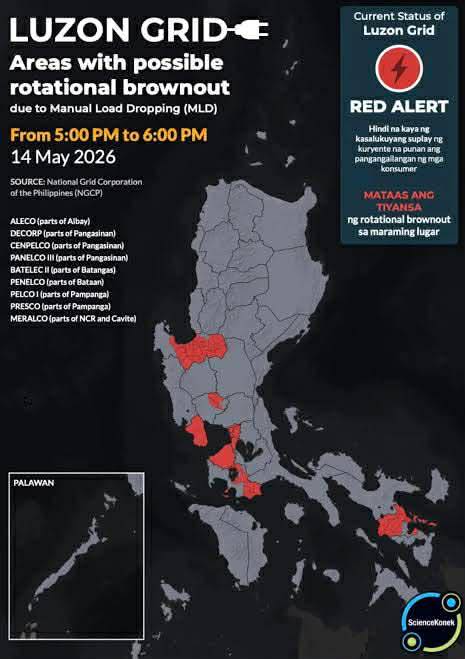
The recurring red and yellow alerts in the Luzon and Visayas grids are not merely technical failures, but the result of a deep structural crisis caused by decades of neoliberal energy policies in the Philippines.
The crisis is rooted in the privatization and commodification of electricity under the Electric Power Industry Reform Act (EPIRA) and the Wholesale Electricity Spot Market (WESM). Electricity — an essential public service vital to life, health, transportation, communication, education, and production — which has been transformed into a commodity traded in the market for profit.
2. The WESM System Raises Electricity Prices Amid Scarcity
When global oil prices spike due to geopolitical conflicts—such as a US–Israel war on Iran and resulting disruptions around the Strait of Hormuz—it significantly raises electricity costs under the Philippines’ market-based power system. Market-driven structure like WESM amplifies and transmits those shocks much more directly into electricity prices than a regulated or planned system would.
Reducing the country’s dependency on imported fossil fuels by transitioning to renewables can help stabilize the Philippine energy system, but only if it is implemented within a socially planned and publicly oriented framework. There is no purely technological fix for the problem.
Under the WESM system, power shortages become a source of profit for corporations.
Every red alert, every forced outage, and every tightening of reserve margins becomes an opportunity for power oligarchs and energy corporations to earn massive profits through WESM pricing, emergency dispatch, and scarcity-driven electricity charges.
While the people suffer from brownouts, rising electricity rates, and increasing prices of goods — fossil-fuel conglomerates reap enormous profits. This is unjust.
WESM operates as a “marginal pricing system” — meaning the most expensive megawatt (MW) needed to meet demand sets the price for all electricity.
During red alerts, high spot market prices are often driven by fuel-based marginal plants (especially diesel and LNG). This structure allows generator companies (operating on relatively cheap coal and hydro) to earn “scarcity rents” — or excess profits adjusted to the increase in WESM prices due to electricity shortages.
Based on the latest data from the Independent Electricity Market Operator of the Philippines (IEMOP), the spot market price in the Philippines ranges from around ₱12/kWh in Luzon to more than ₱30/kWh in some parts of Mindanao, reflecting severe supply stress.
Coal plants may experience up to 200%+ increases in profits under scarcity pricing when market prices surge far above the relatively low production cost of electricity.
3. Corporate Winners of the Energy Crisis
The WESM structure enables large corporations to extract windfall profits during electricity shortages.
Among the main beneficiaries during red alerts are large generators such as San Miguel Corporation and Aboitiz Power Corporation, which have extensive exposure to coal and flexible generation assets. Also included are First Gen Corporation of the Lopez family, ACEN Corporation of the Zobel de Ayalas, and Team Energy Corporation owned by Japanese corporations Marubeni and Jera.
They control large portions of coal, gas, LNG, and other energy infrastructure that directly affect grid stability and electricity prices.
While these corporations enjoy windfall profits, the Filipino consumer and other industries in the country bear the burden of rising electricity costs.
4. The Problem is the Market Structure
The power crisis is not simply a problem of fossil-fuel dependence. The deeper problem is the market-driven structure of the energy sector.
Replacing the fossil-fuel oligarchy with renewable-energy capitalists is not a solution. Renewable energy under a market-based system will merely continue the logic of oligarchic profit accumulation at the expense of the people.
Likewise, it must also be ensured that existing renewable energy projects do not produce major negative impacts on society and the environment — including the displacement of indigenous peoples from areas where energy systems are located, the destruction of mountains and ancestral lands, disruptions to fishing and the livelihoods of fisherfolk, and the lack of a serious waste and disposal plan for solar panels and other technologies.
What matters is not only the type of energy being produced, but who controls it, what it is produced for, and the accountability of those operating it toward environmental and ecological protection.
Renewable energy cannot genuinely serve the masses so long as energy remains under market control, operated for profit by giant private corporations.
5. Decommodification of Electricity
The central issue is the decommodification of electricity.
Electricity should not be treated as a commodity sold at the highest price through WESM. It must be treated as a public service and a social right.
The energy sector must serve social needs through democratic planning, environmental and ecological protection, and universal access for all — not through scarcity pricing and corporate profit accumulation.
The repeated failures of the privatized system of essential public services demonstrate the limitations of private capital in advancing strategic infrastructure. Private investment cannot adequately develop long-term reserve capacity in energy, smart grids, transmission modernization, and a full 100% renewable transition. These require state planning.
6. Program for Transformation
The solution to the power crisis requires:
• reversing privatization and returning the energy sector to public ownership;
• abolishing the market-driven system through the dismantling of WESM;
• nationalization of major power assets;
• expansion of public ownership and democratic workers’ control;
• state investment in grids, storage, transmission, and renewable infrastructure;
• funding the transition through public revenues and wealth taxes; and
• a planned transition toward 100% renewable energy.
7. Workers’ Control of the Energy System
The transition toward a public and socialized system must include workers’ control over the power sector — not merely a transfer of ownership, but democratic control over operations, planning, and the advancement of public service for all.
This includes the immediate rehiring of retrenched, casualized, and subcontracted technicians, engineers, and administrative staff affected by privatization and outsourcing in the sector. These workers possess vital knowledge in the operation of energy generation, transmission, and distribution that is critical to stabilizing the entire system.
The workforce in the energy sector must also be expanded, reversing decades of cost-cutting, contractualization, and understaffing that have weakened maintenance capacity and increased vulnerability to brownouts and red alerts.
A worker-controlled system would implement:
• regularization of all workers;
• returning outsourced and contractual workers to core operations;
• expansion of technical staffing for maintenance and grid management;
• democratic worker participation in decision-making; and
• prioritizing public interest over profit.
Under such a system, it will not be lean privatization but adequately staffed, safe, and empowered labor that will strengthen energy security.
8. Fundamental Principle
People must come before profit and the market.
Electricity is a public service, not a commodity.
Energy must be democratically planned for social need, not for corporate interests. #
May 16, 2026

