[POSITION PAPER]
Philippines: AI, Industrial Sovereignty, and Pax Silica
The Struggle for Sustainable Industrial Development, Technological ‘Self-Determination’, and National Sovereignty
By Reihana Mohideen, PLM-International
View: [VIDEO] ‘In an era marked by AI, is the Marxist Labor Theory of Value still valid?’
I. Pax Silica: A New Geopolitical-Industrial Order
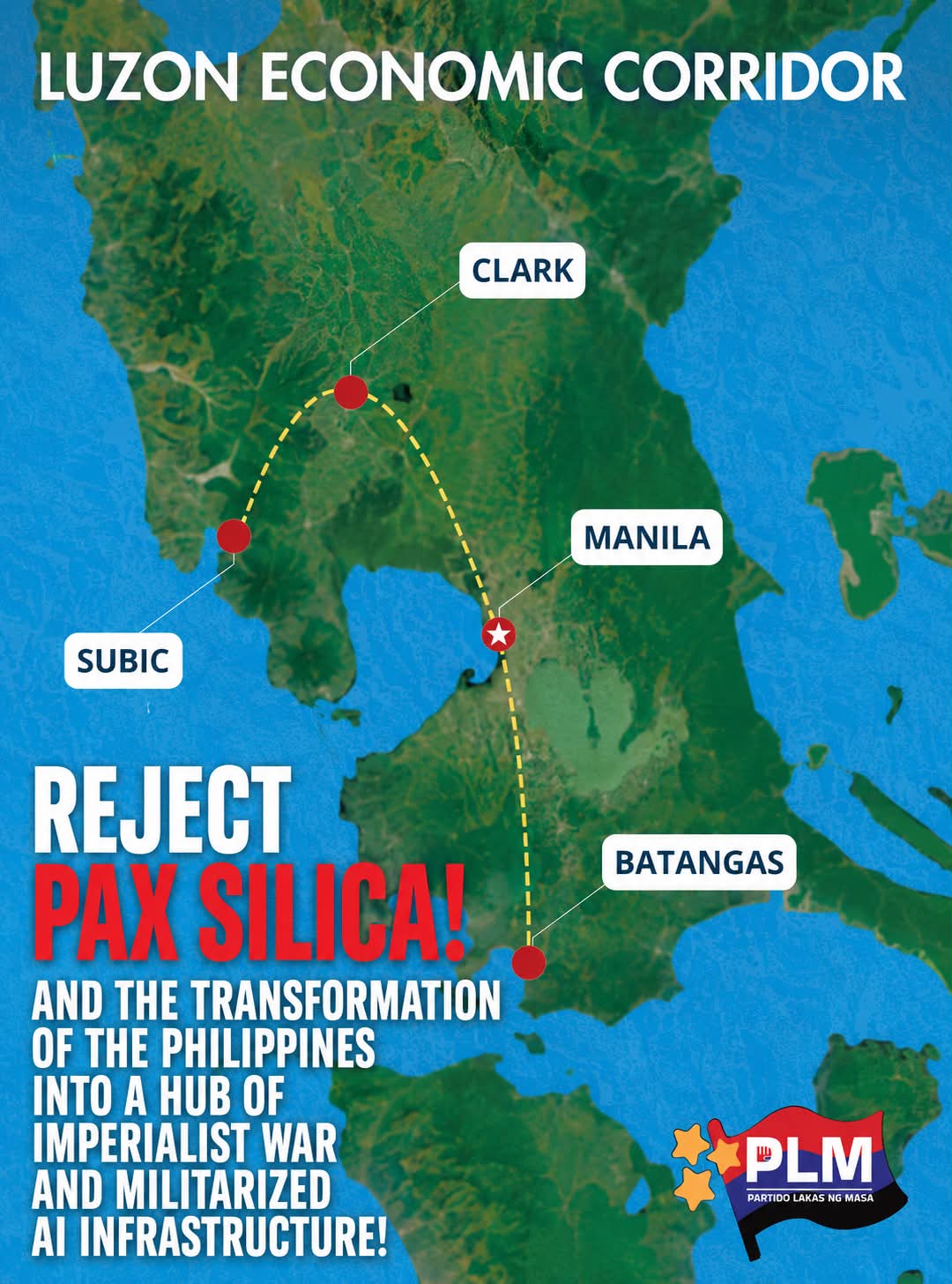
In December 2025, the US established Pax Silica, a ‘strategic initiative’ along with 14 other high-tech countries, to counter China’s strength in semiconductors, artificial intelligence (AI), and high-level technology (HLT) through US control of supply chains — from critical minerals, energy, and logistics to semiconductors, advanced manufacturing, AI infrastructure, software platforms, and frontier AI models. The Philippines joined the initiative in April 2026. Under the initiative, the Philippines and the US are planning to establish a 1619-hectare industrial/AI hub in the Luzon Economic Corridor — an ‘economic security zone’ – to shore up US supply chains.
[Artificial Intelligence refers to the simulation of human intelligence by digital devices, performing tasks such as learning, reasoning, problem-solving, and decision-making, through techniques like machine learning, neural networks, and natural language processing (Russell & Norvig, 2021).]
Pax Silica is a US-led reorganization of global production driven by geopolitical rivalry and the fusion of industrial policy with military strategy. It seeks to build “trusted ally” supply chains that limit China’s access to advanced technologies while integrating partner countries into segmented roles within a US-aligned technological bloc.
Rather than a single agreement, it operates through infrastructure investments, supply-chain restructuring, security arrangements, and industrial partnerships. The Philippines is being incorporated via mineral agreements, semiconductor expansion, AI-linked industrial corridors, logistics projects, nuclear energy development, and deeper defense cooperation.
At the center of this architecture is EDCA, which enables rotational US military access, prepositioning of equipment, logistical integration, and the development of dual-use infrastructure connected to wider Indo-Pacific strategic planning. In this framework, economic integration is layered onto existing military architecture.
This paper argues that the Philippines risks becoming a low and at best a mid-level semiconductor processing node, a logistics corridor integrated into US military supply chains, a supplier of critical minerals and technical labor, and a forward-positioned territory within broader US Indo-Pacific security strategy.
The request by the US to place the hub under US law and grant diplomatic immunity to US personnel is a clear indication of the military underpinnings of this venture.
The arrangement also aligns with key Philippine elite interests by attracting investment, strengthening export sectors, and reinforcing political and security ties with the United States.
The initiative is being hailed as an opportunity for high-level technology (HLT)-based development.
The question posed, therefore, is how the rise of high-level technologies such as AI enables national industrial development grounded in sovereignty, technological self-reliance, and sustainable development in the Philippines? Will HLT become a tool for national industrial transformation and social development, or will it function as a mechanism for deeper dependency under a global techno-military order?
II. High-Level Technology Under Capitalism
HLT technologies are not neutral. They are deeply embedded within imperialism’s military-industrial complex, global supply chains, and class structures of ownership. Within the framework of global capitalism or imperialism, the global AI industry combines highly advanced computing infrastructure in major capitalist powers with vast reserves of precarious digital labor in low-wage countries, reproducing unequal international divisions of labor facilitating the significant transfer of value to the HLT and imperialist countries.
Neither is AI a ‘new economy’ that functions autonomously from capitalism. AI models cannot function and produce a single output without an enormous expenditure of labor — human-created data, software engineers to design highly complex system architectures, human-produced infrastructure, such as electricity to run server farms, and human maintenance, and ‘hidden’ human labor in low-wage countries such as the Philippines, to clean, label, sort and verify data used for training algorithms (machine learning). AI under capitalism is a part of the ‘constant capital’ or ‘dead labor’ that transfers value, not creates it, following Marx’s Labor Theory of Value. (Stavros Mavroudeas, 2026)
The central issue is therefore not simply whether the Philippines adopts AI and high-level technologies, but under whose control these technologies are developed, and toward what developmental objective they are directed.
III. Structural Constraints of the Philippines
The Philippines possesses several partial advantages within the global technology economy. These include participation in electronics assembly, an established IT-BPM and service-sector workforce, substantial mineral resources such as nickel, and emerging semiconductor back-end capacity involving assembly, testing, packaging, and electronics manufacturing services.
At the same time, the country remains structurally weak in critical areas necessary for sovereign industrial development. The Philippines lacks a strong heavy industrial base, machine-tool industries, energy sovereignty, advanced semiconductor design and fabrication capabilities, robust public research and development systems, and coordinated long-term industrial planning. This creates a core problem for the Philippine economy: the country participates in global technology chains without controlling its highest-value and most strategic segments.
IV. High-Level Technologies and the Requirements of Sovereign Development
AI as a Transformative High-Level Technology: High-level technologies such as AI possess significant transformative potential. When combined with robotics and advanced industrial systems, AI can enable industrial automation, productivity growth, logistics optimization, infrastructure coordination, semiconductor design, advanced manufacturing, disaster prediction, climate resilience, healthcare modernization, and improvements in agricultural productivity. These technologies are increasingly becoming foundational to industrial development across the world economy.
However, these capabilities are not autonomous; they depend upon deeper material foundations. AI is fundamentally infrastructural, with energy, land, and water functioning as first-order constraints on its development and deployment. In the Philippine context, these constraints are particularly acute: electricity prices remain among the highest in Asia, energy security is weak, grid fragmentation persists, and infrastructure vulnerability to climate disasters is severe. At the same time, land reform remains incomplete and, in key instances, subverted, further complicating the territorial basis for large-scale industrial and digital infrastructure.
Energy Demands and Infrastructure: Because AI workloads and high-performance computing generate enormous heat, cooling has become one of the biggest technical and energy challenges in modern data centres. Large-scale data centres and semiconductor ecosystems require stable baseload electricity, high-capacity transmission systems, advanced cooling infrastructure, water supplies and water infrastructure, and resilient logistics networks. For hyperscale AI infrastructure operated by companies like Google Cloud, Microsoft, Amazon Azure, and Meta, cooling infrastructure can become as large and capital-intensive as the computing infrastructure itself. At present, the Philippines does not possess the degree of energy sovereignty necessary, as demonstrated by the energy crisis gripping the country for independent large-scale AI-industrial development. As a result, expansion in this sector risks deepening structural dependence on private energy oligopolies, imported fuels, and externally financed grid development.
Pax Silica and the Civil-Nuclear Energy Agenda: Energy is a key HLT infrastructure requirement. The focus of Pax Silica is the development of ‘civil-nuclear energy’ (US Embassy Fact Sheet). This includes, based on the US-Philippines “123 Agreement” on nuclear cooperation, deployment of American-designed small modular reactors (SMRs) by Meralco, the establishment of a nuclear reactor control room simulator and training hub, and partnerships between Philippine universities and overseas institutions such as Texas A&M University and King’s College London. This nuclear program aims to integrate the Philippines into US-linked nuclear technology and supply chains. Renewable energy such as solar and wind are not mentioned, even in relation to energy security and therefore sovereignty.
AI as an Infrastructural Dependency Chain: AI systems further require integrated industrial ecosystems: semiconductor design and manufacturing capacity, stable and affordable energy systems, hyperscale data centers, high-capacity telecommunications and fiber networks, scientific and engineering talent pipelines, and secure access to critical minerals and industrial inputs. Without control over these underlying foundations, AI development becomes dependent on outsourced computing systems, foreign cloud platforms, and externally governed digital ecosystems dominated by major technology powers such as the United States, Japan, the European Union, and China.
Within this configuration, AI development is not simply a technological transition but an infrastructural dependency chain. The absence of sovereign control over critical inputs means that digital-industrial expansion is structurally mediated by external capital, fuel supply volatility, and privatized generation capacity. This shapes not only the cost structure of AI deployment but also its strategic autonomy, embedding technological development within broader patterns of dependency.
“Trusted Partnerships” and Emerging AI Blocs: In this light, the discourse of “trusted partnerships” under frameworks such as the World Economic Forum (WEF) is useful to examine. This reflects an emerging language of “AI sovereignty” that emphasizes secure supply chains, allied infrastructure, and coordinated compute ecosystems. This closely parallels the strategic logic of Pax Silica: the formation of geopolitical technology blocs organized around trust, security, and interoperability. For the Philippines, however, these partnerships are mediated not only economically but also militarily through arrangements such as EDCA and broader US strategic integration. The key issue is therefore not partnership per se, but hierarchy: the Philippines does not negotiate from a position of technological parity, but from within a structured asymmetry of power.
Under such conditions, the Philippines risks participating in AI development only as a subordinate service provider within foreign-controlled technological systems. As a result, technological modernization under present conditions risks reproducing dependency rather than overcoming it.
V. Comparative Development Models
A. Taiwan: Industrial Upgrading Through State-Led Industrial Policy
The experience of Taiwan demonstrates that technological advancement is possible through sustained state-led industrial policy, strong STEM education systems, strategic protection and upgrading of domestic industries, and coordinated technology transfer mechanisms. Through long-term industrial planning, Taiwan successfully moved from low-end assembly operations toward global leadership in semiconductors and advanced electronics.
Institutions and firms such as Taiwan Semiconductor Manufacturing Company, Acer, and Foxconn emerged from this process of industrial upgrading.
However, Taiwan’s success also remains structurally tied to deep integration within US-led supply chains, dependence on global export markets, and geopolitical exposure within the broader US–China rivalry. Taiwan illustrates both the possibilities of technological upgrading and the vulnerabilities created by dependence on externally structured geopolitical and economic systems.
B. Cuba: Scientific Sovereignty Under Constraint
The experience of Cuba presents a different developmental model. Following the 1959 revolution, Cuba developed a state-led scientific system centered on universal education, centralized research institutions, public health-oriented innovation, and scientific planning. Institutions such as Center for Genetic Engineering and Biotechnology (CIGB) and BioCubaFarma enabled Cuba to achieve world-class biomedical innovation in vaccines, pharmaceuticals, and preventive healthcare despite severe economic constraints. Cuba demonstrates that high technological capability can exist without industrial capitalism at a massive scale.
However, Cuba’s model also faced limitations imposed by a US economic embargo, which for sixty-six years restricted access to global capital markets, limited industrial scale, and the absence of a broad heavy industrial base. [RM1.1]
The aim of the US was regime change in Cuba, which has now intensified under the Trump administration, which is threatening direct military intervention to bring this about. The fact that Cuba has managed to survive until now is a testimony to the resilience of the Cuban revolution and its socialist system.
Together, Taiwan and Cuba represent two different responses to structural position within global capitalism. Taiwan pursued industrial upgrading through strategic integration into global production systems, while Cuba pursued scientific sovereignty and public-sector innovation under conditions of relative isolation.
The Philippines currently occupies neither position. It is neither industrially upgraded like Taiwan nor scientifically autonomous like Cuba. Instead, it remains integrated primarily into low-value service, assembly, and extractive sectors within global supply chains.
VI. Implications: Sovereignty Eroded
The primary danger posed by Pax Silica is that infrastructure developed within this framework increasingly serves both economic and military purposes. Industrial policy becomes aligned with external security priorities, while technology transfer remains conditional and hierarchically controlled. Strategic sectors such as semiconductors, logistics, telecommunications, and energy become integrated into systems whose highest levels of ownership, design capability, and operational coordination remain external to the Philippines.
This integration also deepens long-term dependency. Once infrastructure, investment flows, export markets, military coordination, and technological systems become integrated into US-aligned networks, disengagement becomes economically and politically costly. In effect, sovereignty is not formally abolished but progressively narrowed through layered economic, technological, and military integration.
Pax Silica presents itself as modernization and technological progress, but structurally it represents a securitized global production system organized around US strategic interests. For the Philippines, the decisive question is whether AI and high-level technologies will enable industrial sovereignty and social development, or whether they will reinforce the country’s role as a managed periphery within a global military-industrial order.
The experiences of Taiwan and Cuba demonstrate that technological development is possible under very different historical conditions. However, both cases show that technological advancement ultimately depends on state capacity, ownership of productive assets, control over technological systems, and strategic autonomy.
Without these foundations, AI and high-level technologies do not produce sovereignty.
They produce incorporation and subordination.
VII. The Role of AI in This System
Within Pax Silica, AI functions primarily as a productivity and coordination layer within global supply chains. It supports industrial automation, logistics optimization, surveillance systems, military planning, and data management. AI is therefore inseparable from the broader geopolitical and military-industrial restructuring currently underway.
However, without domestic control over semiconductors, compute infrastructure, energy systems, and industrial design capacity, AI development remains dependent on foreign technological ecosystems. Under these conditions, AI becomes a mechanism of participation within externally controlled systems rather than a foundation for technological sovereignty. The Philippines may therefore contribute labor, infrastructure, minerals, logistics, and low-to-mid-level technical functions while remaining excluded from the highest-value and most strategic levels of technological production.
VIII. A Socialist Alternative
Beyond the immediate tasks of national-democratic development and industrialization lies the broader socialist transition. Under capitalism, production is governed primarily by markets, profit maximization, and the treatment of labor power as a commodity. A socialist transition seeks progressively to subordinate these mechanisms to democratic social planning, collective ownership, and production oriented toward human need rather than private accumulation — the conscious curtailment of the law of value as the central organizing principle of economic and reproductive life.
Such a transition would require reversing privatization in strategic sectors and reestablishing public ownership and democratic management over key areas of the economy, including energy, transport, telecommunications, finance, water, major infrastructure systems, as well as comprehensive agrarian reform. This would need to be combined with workers’ control, and integrated national planning capable of coordinating industrial development, scientific advancement, ecological sustainability, and social welfare. Rather than leaving investment decisions to private capital and global market pressures, economic priorities would increasingly be determined through democratic planning mechanisms rooted in socially necessary and useful priorities.
Within such a framework, high-level technologies and artificial intelligence would no longer primarily serve corporate profitability and imperialist competition. Instead, HLT and AI would be directed toward socially necessary production and long-term human development. Their primary functions would include strengthening public healthcare systems, improving disaster prediction and climate resilience, supporting universal education, renewable energy systems, modernizing sustainable agriculture and food security systems, and coordinating infrastructure according to ecological and social priorities rather than private profit.
A socialist approach to AI and industrial development would therefore treat technology not as an autonomous force or commodity, but as part of a broader project of social transformation. Technological progress would be evaluated according to whether it expands democratic control over production, reduces social inequality, strengthens collective welfare, restores ecological balance, and deepens national and popular sovereignty.
The long-term objective is not merely industrial growth, but the transformation of the social relations that govern production and reproduction.

