A Guide for PLM’s Political Discussion
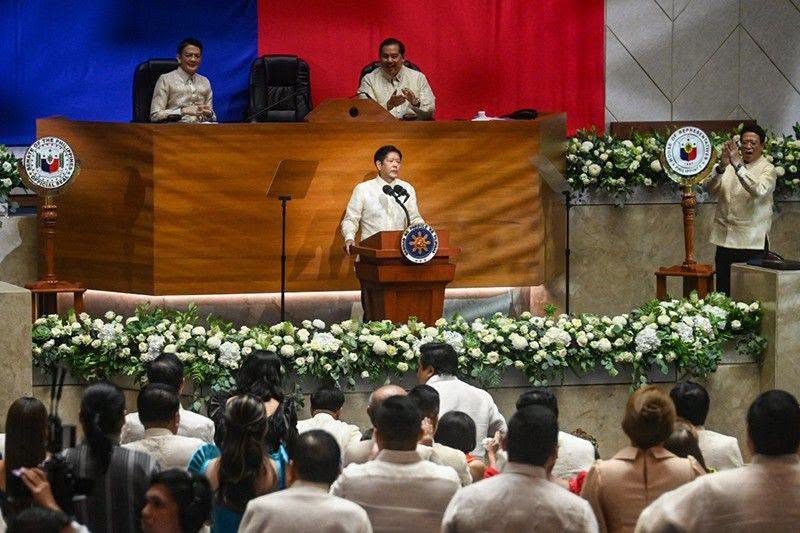
1. Much has already been said about President Ferdinand Marcos Jr.‘s State of the Nation Address. Many criticisms have focused on his unfulfilled promises, statistics that fail to reflect the people’s actual conditions, and programs presented as benefiting everyone but which primarily serve big business and the ruling class.
2. As a socialist organization, however, our analysis must go deeper. Our task is not merely to evaluate the president’s administrative performance.
3. We examine the character of the state he leads, the class interests it serves, and why successive administrations – past and present – have repeatedly failed to resolve the crises of poverty, exploitation, and oppression that continue to bind the Filipino people.
4. The answer is straightforward: these crises are not simply the product of Marcos Jr.’s presidency, but of the system he represents. The system is the root cause, while the failures and betrayals of those in power only deepen the crises it creates.
5. Marcos Jr.‘s SONA did not come from the people. It was not the product of consultation with the masses about their real conditions. It was crafted by the president and his speechwriters to construct a narrative detached from reality. Yet despite this effort, Marcos’ own speech inadvertently exposed the true nature of the Philippine state.
FIRST, corruption is not merely the wrongdoing of a few politicians – it is built into the system itself
1. Marcos Jr.’s declaration that corruption cases should proceed against his cousin Martin Romualdez is political theater and an exercise in scapegoating. Romualdez has been cast as the fall guy to shield many others – including Marcos himself – from accountability.
2. It is widely understood that corruption extends far beyond one individual. Marcos himself has faced allegations, as have many within the government. Corruption is not simply the result of dishonest officials; it is the product of a political system that has transformed the state into a business enterprise for those who control it.
3. From top to bottom, government has long been dominated by political dynasties, their cronies, oligarchs, and large landowners. The bureaucracy is used to accumulate wealth, reward political allies, finance electoral machines, and preserve elite rule.
4. In this sense, political dynasties are the concrete expression of elite bureaucratic rule. They are not merely families in politics – they are the institutional mechanism through which the oligarchy maintains control over the state. As long as this system remains, corruption will continue regardless of who occupies Malacañang.
5. It is no accident that virtually every faction of the ruling class has its own political dynasty. Dynasties are the principal means through which elite power reproduces itself across generations.
6. For socialists, therefore, campaigns against individual corrupt officials or appeals for “good governance” are insufficient. Corruption cannot be eliminated without dismantling the political power of dynasties and the oligarchy itself.
SECOND, the SONA reveals that the state’s real economic program remains neoliberalism
1. Marcos Jr. highlighted economic growth, infrastructure projects, and rising investments. Yet none of these alter the economic direction followed by every administration since Corazon Aquino. The governing framework adopted by successive Philippine governments has remained neoliberal capitalism.
2. Neoliberalism is founded on the capitalists’ assertion that the commanding sectors of the economy should be entrusted to private capital while the role of the state is reduced. Public services that were once regarded as social rights – including employment, housing, health care, education, water, electricity, and other essential services – have increasingly been transferred to private corporations as sources of profit.
3. This is reflected in five core government policies (easily remembered through the acronym PLDT Co.):
• Privatization — selling or transferring public services to private ownership.
• Liberalization — opening the economy to unrestricted foreign capital and imports.
• Deregulation — reducing government regulation over large corporations.
• Taxation — regressive taxation or shifting the tax burden onto ordinary people through VAT and other indirect taxes.
• Contractualization and labor flexibilization — weakening job security and workers’ bargaining power.
4. If we revisit Marcos Jr.’s claims that his administration has delivered extensive services to the people, these are among the examples he cited:
• Cash assistance programs (AICS, YAKAP, and others), which function largely as instruments of political patronage benefiting trad•itional politicians, including the administration itself.
• His appeals to oil companies to stagger fuel price increases rather than imposing them all at once. This does not lower fuel prices. The structural solution – which the administration refuses to consider – is restoring public ownership of Petron and breaking the control of the oil cartel.
• The temporary suspension of excise taxes on LPG and kerosene during the crisis, only for these taxes to return while prices remain high. A genuine solution would be to permanently abolish VAT and excise taxes on petroleum products.
• Repeated job fairs, while more than two million Filipinos remain unemployed and millions more remain underemployed.
• The ₱20 rice program in selected pilot areas, while market prices continue to range between ₱40 and ₱50 per kilogram for most consumers.
• The promise to eliminate systems loss charges in electricity, while right now, Manny Pangilinan of PLDT laments the impending loss of additional profits despite billions earned in the first half of this year. The underlying issue is that electricity remains a profit-making enterprise instead of a genuine public service under public ownership.
• The opening of the North-South Commuter Railway and MRT-7, both of which remain tied to private corporate control. The NSCR operates under a Public-Private Partnership arrangement, while MRT-7 is owned by Ramon Ang’s San Miguel Corporation. Public transportation should be publicly owned and operated as an essential public service.
• Promotion of the Waste-to-Energy (WTE) program, despite its reliance on incineration, environmental risks, and the displacement of communities, including those in Tondo. The principal beneficiaries are major corporations, including R2 Builders owned by Reghis Romero. Romero’s company also figured prominently in the legal challenge that suspended the legislated wage increase for workers.
• Claims of successful agrarian reform, even as landlords continue recovering land through court rulings and the elite promotes land conversion away from agriculture. Hundreds of farmers have recently camped outside the Department of Agrarian Reform to protest these developments.
• Expansion of the Malampaya drilling project, whose primary beneficiaries are oligarchic business interests such as Prime Energy and Udenna Group. The awarding of these contracts has also generated controversy over the absence of competitive bidding.
• Promotion of nuclear power, including renewed discussion of the Bataan Nuclear Power Plant – a Marcos Sr. project that was shelved after sustained public opposition and continuing safety concerns.
• The 4PH housing program, which fails to address the housing backlog because construction has been delegated to private developers. Units costing around ₱1.2 million and more remain beyond the reach of poor families. Housing has become a business rather than a public service.
• The continued use of Contract of Service (COS) and Job Order (JO) workers, who remain contractual employees without tenure or full employment benefits. The government itself perpetuates labor contractualization.
• The Universal Health Care program, while Filipino patients continue to shoulder high out-of-pocket medical expenses and still lack genuinely free and comprehensive health care comparable to that available in many other countries.
5. These are only some of the initiatives Marcos Jr. highlighted in his SONA. Equally revealing are the issues he chose to ignore – among them the country’s low wages compared with the rest of Asia, continuing labor contractualization, the deepening agricultural crisis, the absence of genuine national industrialization, the lack of a serious climate strategy, and many other urgent concerns confronting ordinary Filipinos.
6. The socialist response to these issues is clear: the solution is not pleading with oligarchs, nor handing over public services for private profit, nor relying on new investments based on cheap labor and raw material exports.
7. The alternative is public ownership of the commanding heights of the economy and essential public services, managed under workers’ and people’s control – a transitional system in which workers and people’s organizations participate directly in management and possess real decision-making and veto powers over policies that undermine public welfare.
THIRD, the continuing subordination of the Philippines to U.S. imperialism
1. Marcos Jr.‘s SONA also contained several admissions that reveal the Philippines’ growing subordination to the strategic and geopolitical interests of the United States:
• The promotion of the Pax Silica project, whose AI industrial hub to be built in New Clark City is linked to U.S. strategic interests in artificial intelligence, semiconductors, and the military-industrial complex. It will rely on Philippine critical minerals, land, energy, and water, while leaving the country with limited sovereignty over its operations and significant environmental risks.
• His closing remarks on the West Philippine Sea, which omitted discussion of the country’s increasing integration into the U.S. strategy of containing China.
• The expansion of EDCA sites from the original five under President Benigno Aquino III to nine under Marcos Jr. These are effectively U.S. military facilities located inside AFP camps. Under Marcos Jr., they have also become sites for missile deployments and other military weapons directed toward China.
• The expansion of security agreements, including GSOMIA and broader intelligence-sharing arrangements with the United States, alongside negotiations for similar agreements with Japan. These developments further increase the danger of conflict in the Indo-Pacific while serving interests that are not those of the Filipino people.
2. The socialist position is that the Philippines should not align itself with any great power. Replacing dependence on the United States with dependence on China – as pursued under the Rodrigo Duterte administration – is no alternative. Such a policy did not represent genuine independent foreign policy but merely shifted geopolitical patronage in pursuit of investment and political advantage.
3. Socialists advocate a genuinely independent foreign policy based on national sovereignty, peace, mutual cooperation, and the interests of the Filipino people – not on participation in rivalries among imperialist and hegemonic powers.
4. Allowing Philippine territory to be used as part of preparations for war places the Filipino people themselves at immediate risk.
Why reforms alone are not enough
1. Socialists do not reject reforms. On the contrary, we support every reform that immediately improves the conditions of the people. Yet history repeatedly demonstrates that reforms unaccompanied by structural changes in political and economic power are eventually reversed.
2. Land reform has been promised repeatedly, yet vast tracts of land have ultimately returned to landlord control. Wage increases are periodically granted, only to be eroded by inflation, rising prices, and legal or administrative measures that reduce workers’ real incomes and benefits.
The socialist alternative: system change, not merely regime change
1. Replacing one president or one faction of the ruling elite with another is not enough. Experience has repeatedly shown that unless the political, economic, and social system itself is transformed, only different representatives of the same ruling class rotate through government.
2. The responsibility of socialists is therefore not merely to criticize the present administration, but to demonstrate the necessity of changing the system itself.
A Gobyerno ng Masa (Government of the Masses)
1. Socialists therefore advance the call for the establishment of a Gobyerno ng Masa as the genuine democratic alternative.
2. Such a government would rest upon the organized power of the people. It would be composed of representatives of exploited and oppressed classes together with organized social movements, including workers, farmers and fisherfolk, the urban poor, women, youth and students, Indigenous Peoples, LGBTQIA+ communities, patriotic professionals, progressive people of faith, environmental movements, and other democratic forces.
3. These classes and movements are qualified to govern because they have been forged through long struggles for their rights and emancipation. Socialists recognize and uphold these struggles as the foundation of democratic transformation.
4. A Gobyerno ng Masa would advance a transitional program that expands democratic rights, dismantles the political power of dynasties and oligarchs, establishes democratic control over the economy, and prepares the way for a peaceful yet profound transformation of society toward socialism.
Conclusion
1. PLM is a socialist organization. Our struggle is not simply for “good governance” or a better style of administration.
2. Our struggle is for a Gobyerno ng Masa that places exploited and oppressed classes and organized social movements at the center of political power – not to create a more humane capitalism, but to build a socialist society founded on genuine democracy, equality, and the abolition of all forms of exploitation and oppression.
3. This is our task. This is our path. This is our future.
Partido Lakas ng Masa
July 31, 2026

