
In Session: Socialist School 5 – The Cuban Revolution and the Struggle for Socialism Today
1. Good afternoon to all of you. I want to appreciate the opportunity to exchange with you, and also I want to appreciate the opportunity for all the participants that have joined today to talk about the Cuban Revolution and the Struggle for Socialism. Nowadays, we believe that it’s more clear what has been the struggle for progressive forces in different regions, in different countries.
2. Because nowadays, we are facing a lot of uncertainty times across the world. Today it’s more clear what are the interests, in particular, of the United States, that is not recognizing any limits, neither legal, neither moral limits. And the entire world is facing difficult times since the war of the terrorists have started, in particular for Cuba, where this reality has [happened] 67 years ago when the blockades start.
3. But it has been also the reality since the Cuban Revolution started in 1959. And for us, socialism was a natural outcome of the reality in Cuba before the revolution triumphed.
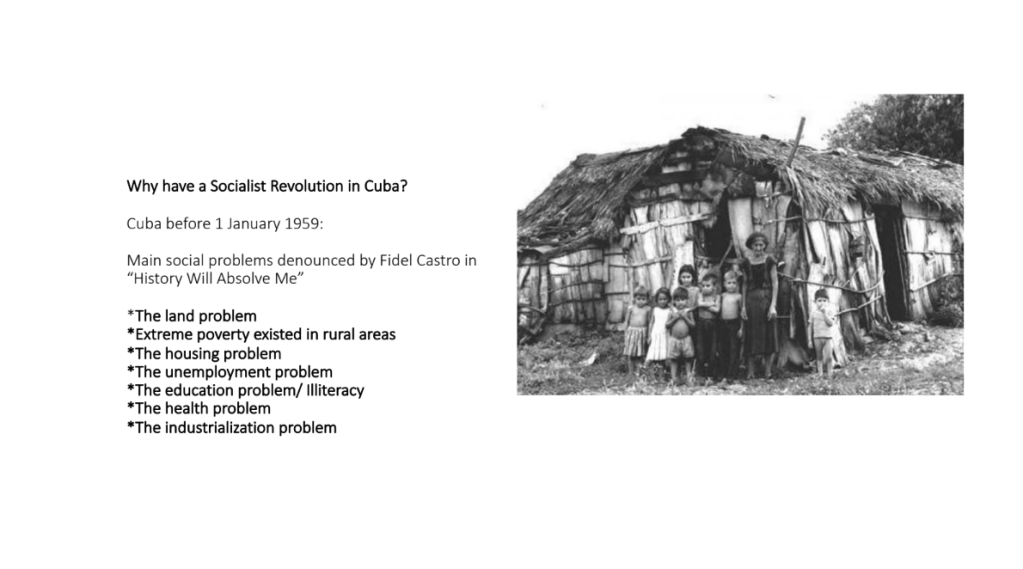
1. This picture is a real image of what was the reality in Cuba before the triumph of the revolution. As you see, this is our people in the countries at that time, and this is why in Cuba was this revolutionary movement, because it was necessary to change that reality. [Picture of people living in hovels.]
2. And this is why our leader, Fidel Castro, whose book, “History Will Absolve Me,” identified the main problems that Cuba have at that time. And this is why a group of people joined when they were very young, because they organized a movement to change the reality of Cuba.
- The main problems at that time were the problem of the land. A lot of foreign companies were the owners of the land in our territories.
- The extreme poverty, in particular, in the rural areas.
- The issue of housing. Even in the cities, the price of rents was almost impossible to pay by the workers.
- The issue of unemployment, in particular, in season where sugar workers do not produce sugar, and don’t have employment at that time.
- Then it was a big problem for Cuba. The education problem, the illiteracy, was a big problem for Cuba. It was incredulous at that time, the reality of it.
- Also, the issue of health problem. Medical care was almost impossible for the majority of families in Cuba before the revolution.
- And the lack of industrialization problems, because Cuba was mainly a producer of sugar at that time.
These problems were identified in details by Fidel Castro, and these are the reasons why in Cuba the revolution triumphed.
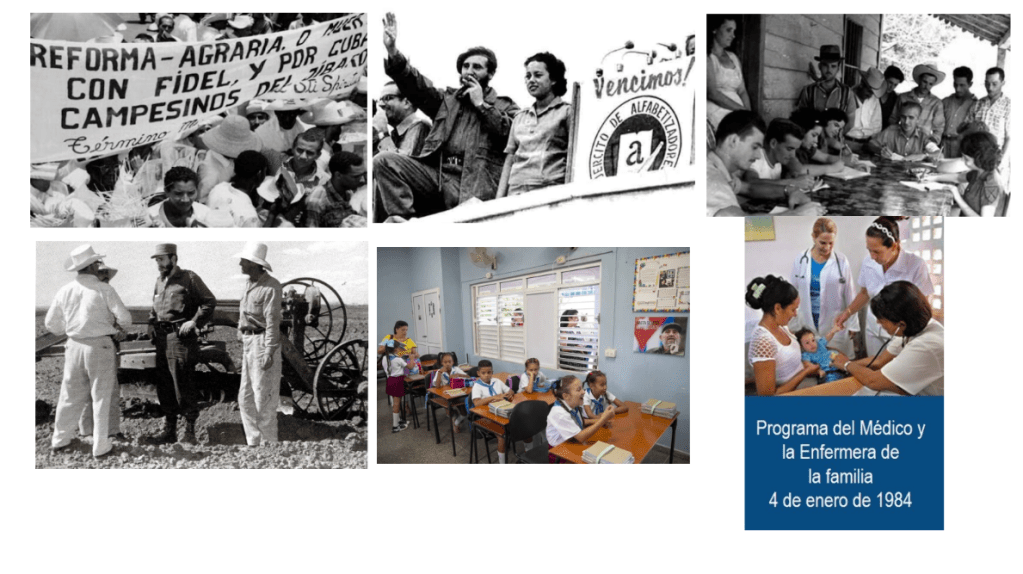
1. One of the first measures adopted by the revolutionary government after 1st of January 1959, we call it in Spanish, Reforma Agraria (Agrarian Reform).
2. It was a movement to give all the farmers the land that they till. For this, of course, we need to undertake a [land] nationalization process. That nationalization process had a very legal basis.
3. The only groups that didn’t accept the compensations that we provided were the Americans and the rich people, the owner of the lands and industries, who went to Florida. And this is why in Florida, there are a lot of organizations that finance subversions against the Cuban revolution, because the revolution ended the exploitation of workers, and for that, we embarked on a land nationalization process, where they didn’t accept the compensations we provided.
4. One of the big achievements of the current revolution was in 1961, when we developed a massive campaign, and Cuba was declared the first territory in Latin America freed of illiteracy. It was a popular movement. And in the image you have to the right were farmers learning how to write and read. And a lot of young Cuban people at that time went to the countries to teach those farmers to eradicate illiteracy, and some of them were killed because the money came from Florida used to start committing terrorism against us. And some of the very young teachers at that time were killed by these terrorist organizations.
5. Then after this, we started the process of industrialization in Cuba, that for a small island, a small economy, was a huge challenge. We also receive international aid for that, and many Cubans were trained in the Soviet Union in different fields of science and industry to develop in our country not only the sugar sector but other sectors of industry.
6. And there is this normal classroom in any school of Cuba. You see, we call it pioneers, our students where we also provide books, et cetera.
7. One of the achievements of the revolution, because it was necessary to finish this problem, was our healthcare system. We have a preventive approach on the healthcare system. What you see in this picture is the nurse and the doctor. We call them family doctors, because in every neighborhood, we establish a small clinic to provide assistance to the families.
8. If the problem of illnesses is more serious, then you will have to go to a hospital, but you will have this [local preventive] treatment in your neighborhood. If a woman is pregnant, a doctor and a nurse will follow you, and after the baby is born, we will follow, and we will have, in this small clinic, all their medical records. And this is why Cuba has reached a high expectancy of life, 77 years.
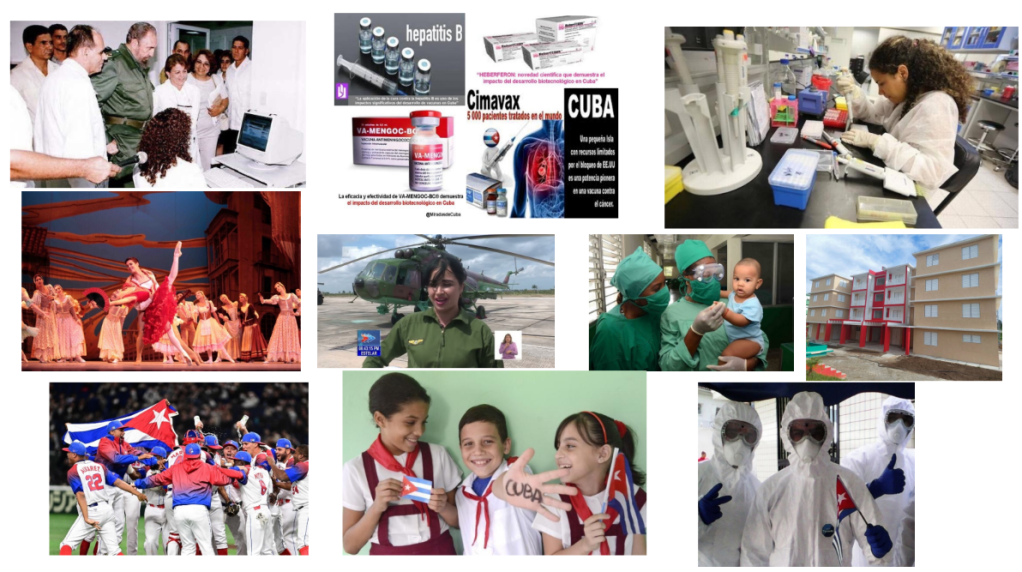
1. To develop science was a visionary approach by our leader, Fidel Castro, that even during the difficult times after the collapse of the Soviet Union, where our incomes dropped, we continue to develop science. And we have developed a biotechnology sector that we feel very proud of because it has been developed under difficult circumstances. Because you know, since the triumph of the revolution, [the United States] established a system of sanctions that we can qualify as the most comprehensive system of sanctions applied to an entire nation.
2. And under these circumstances, the revolution continues in trying to eradicate the problems we identified in 1959.
3. One of the achievements of the revolution was to provide dignity and opportunities to women. The reality that the revolutionary process found was that most of the women didn’t have a level of education when the revolution triumphed. And then we provide a lot of opportunity. The revolution learned, and gave them the opportunity to go to schools, and also to learn, for example, how to do tailoring, etcetera, to provide women the opportunity to be independent and to contribute with salary to families.
4. And the level of development that women in Cuba have reached is also a result of the revolutionary process. Today, we have more than 54% of our parliamentarians who are female. Today, 66% of the technicians and professionals in Cuba are women. In the judicial sector, for example, 84% are women, and this is something that was conquered by the revolutionary process.
5. Me, in my personal capacity, I’m always explaining colleagues that I was born with all the rights already won. This is why, for me, being a girl who was even in a province, not in the capital, it was possible for my family for me to go to university free of charge and to graduate as a lawyer. And after that, I also joined the Ministry of Foreign Affairs of Cuba. This reality of being a diplomat couldn’t be imagined by my family before the revolution triumphed.
6. This is why we really feel very proud of the achievements and the dignity that the revolution provided us. Because one of the programs also of the revolution was to eradicate discrimination. A lot of discrimination before the revolution was against Black people because, you know, in Cuba we are a mix of Spaniards and African slaves that the colonialism brought to Cuba. Because colonialism had extinguished our native people.
7. We don’t have Indigenous people because of that, but we are very proud of our African roots. Then, the issue of discrimination, or any discrimination, is one of the priorities for our revolution, and this is why the opportunities in Cuba were provided to all Cubans. In that picture, you can see for example our maternity program, and we reached good indicators in this program. But I can share that today, the indicators have been seriously damaged due to the consequence of the sanctions.
8. The last indicator is the 9.9 percent infant mortality in Cuba [per 1,000 live births]. And this is one of indicator that is a consequence of the reinforcement of the sanctions, in particular since the first Trump administrations reinforced a lot of sanctions that become obstacles for us, that have damaged our economy, and that have also damaged the opportunity to acquire medicines and medical supplies. This is why those big achievement of the revolution, those achievement of the socialism, has been severely damaged by the sanctions that the Cuban people is facing.
9. Also today our population are facing difficulties. We used to have expectancy of recovery from child cancer to 85%, but today, after the reinforcements of sanctions, it’s only 65%. We usually detect 70% of cancer in our population at stage one or two. But today, we detect cancer 70% only in stage three because there are problems with public transportation due to the sanctions, and in particular, the blockade of fuel.
10. That has been really critical because fuel is indispensable for the survival of the nation. For families, it’s also difficult to have good transportation to go to the hospital when they are sick, despite hospital care is free of charge. But this is clear example how imperialism has really targeted us and put obstacles to damage all the achievements of socialism. In Cuba, also, in the center of the picture, you can see [a Cuban woman] is a pilot, because women have equal opportunities in our country.
11. We also have those buildings in the neighborhood that the revolution built for workers in particular. And also, we have provided free access, universal access to culture and sports. Cuba has reached international recognition on these fields also. Our athletes have earned a lot of Olympic medals, and our National Ballet has earned international recognition too.
12. In this slide, you can also see some of our scientific advancements. In Cuba, the revolution was capable in providing to our people 13 vaccines that we developed locally.
13. Also in this picture, the last picture, is an example of our international solidarity. Because the Cuban revolution and one of the principles of socialism we pursue has been internationalist and humanitarian aid and solidarity. In that picture, you can see the Cuban doctors during the epidemic of Ebola in Africa, where we provided assistance free of charge, because it has been for Cuba, a principle and a duty to share what we have.
14. Solidarity for the Cuban revolution is something that every family support. It’s not a policy of the state. It’s something that is in the idiosyncrasy of the Cuban people. One of the issues that shows in clearer way the success of socialism has been precisely overcoming all those obstacles, sanctions, and lies that, in particular coming from Washington, which they fabricate against Cuba. Nowadays, we are facing the recent lie against us, that is this indictment of the U.S. against our army General Raúl Castro.
15. This is based on lies. Washington is now manipulating an incident in the past on the downing of two aircrafts that violate Cuban airspace. Now they are trying to identify new pretexts to justify new aggression against Cuba, to justify a military aggression, and to justify the genocide they are committing against the Cuban people. Because the public punishment that our people is facing with in this oil blockade is a genocide.
16. And if the socialists haven’t been successful, why do they insist in putting all those pressures and obstacles that have deteriorated the living conditions of the Cuban population? Some leaders in the region, for example, the president of Mexico, has alerted that a humanitarian crisis can occur in Cuba because oil is a vital resource that runs the normal life of any society, in particular, a small island like Cuba.
17. Sometimes imperialism has bad advisors, and we believe they have very bad advisors that know nothing about history, and nothing about the Cuban people. It doesn’t matter how serious is the threat against Cuba. The Cubans will not give up because the independence of Cuba was not a gift. We conquered our independence, our sovereignty, and we have a lot of successful outcomes of socialism that we will continue to defend despite the circumstances today.
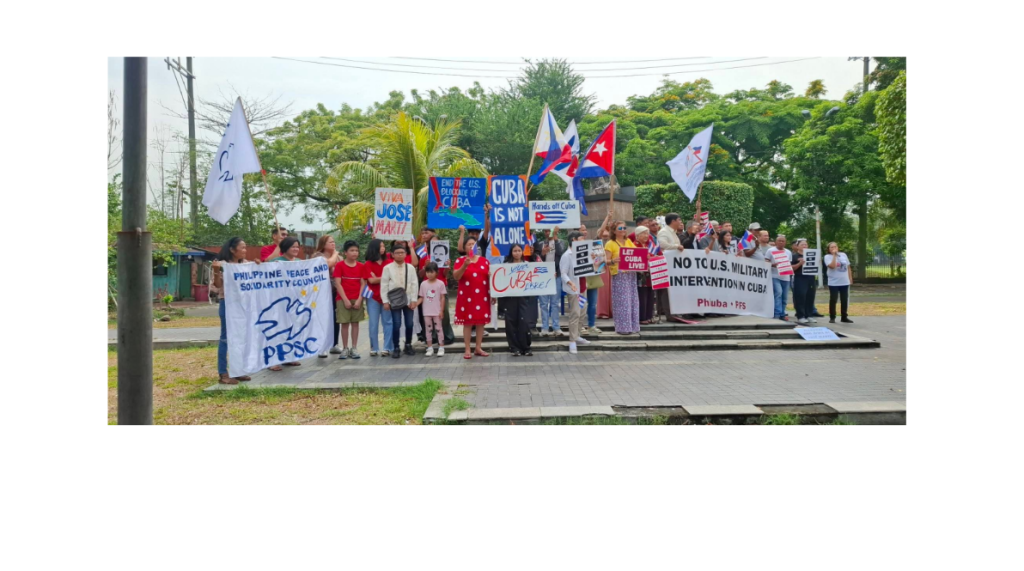
18. And for that, we really appreciate the solidarity that Cuba has received, and in particular from the Philippines. For me, it has been a real pleasure being the ambassador of Cuba to Philippines, because despite being far away, we really appreciate it when our Filipinos friends raise their voices to defend the truth about Cuba, to condemn the aggressions against Cuba, the military aggression, and all the lies against our leader, Raul Castro.
19. For us, those expressions of solidarity and support are really relevant, and our people really appreciate this. For us, this mobilization of the progressive forces is indispensable in the current moment, not only for Cuba, but for all the just causes across the world. It’s indispensable to articulate the progressive forces because the media nowadays are more than ever in the hands of those poor country.
20. And nowadays, they use the new technologies and artificial intelligence, etcetera, for defamation, for misinformation. It’s important that everybody can, since in their personal capacity, they can post in Facebook, in X platforms, their views and their realities. In a way, we need to try to demonstrate to the world what are the realities and the real purposes against the progressive forces and against a country like Cuba.
21. And for us, socialism is possible. Socialism provides equal opportunities in a nation, and this is why we will continue to defend it, and for this, we count on you – our solidarity friends around the world, and in particular, solidarity friends from Philippines – that please let me reiterate the appreciation of the Cuban people for your expressions of solidarity. Thank you very much.
March 23, 2026

