International Political Situation
This report was presented to the PLM National Council meeting on December 20-21, 2025.
The report focuses on the following key aspects:
- Venezuela and Latin America in the Frontline of U.S. Attacks
- U.S. National Security Strategy (NSS) 2025: Revival of the Monroe Doctrine
- Palestine: Gaza and the U.S. Neocolonial Peace Plan
- Our Key Tasks
I. VENEZUELA AND LATIN AMERICA IN THE FRONTLINE OF U.S. ATTACKS
Blockade, Militarisation, and Open Imperialist Claims
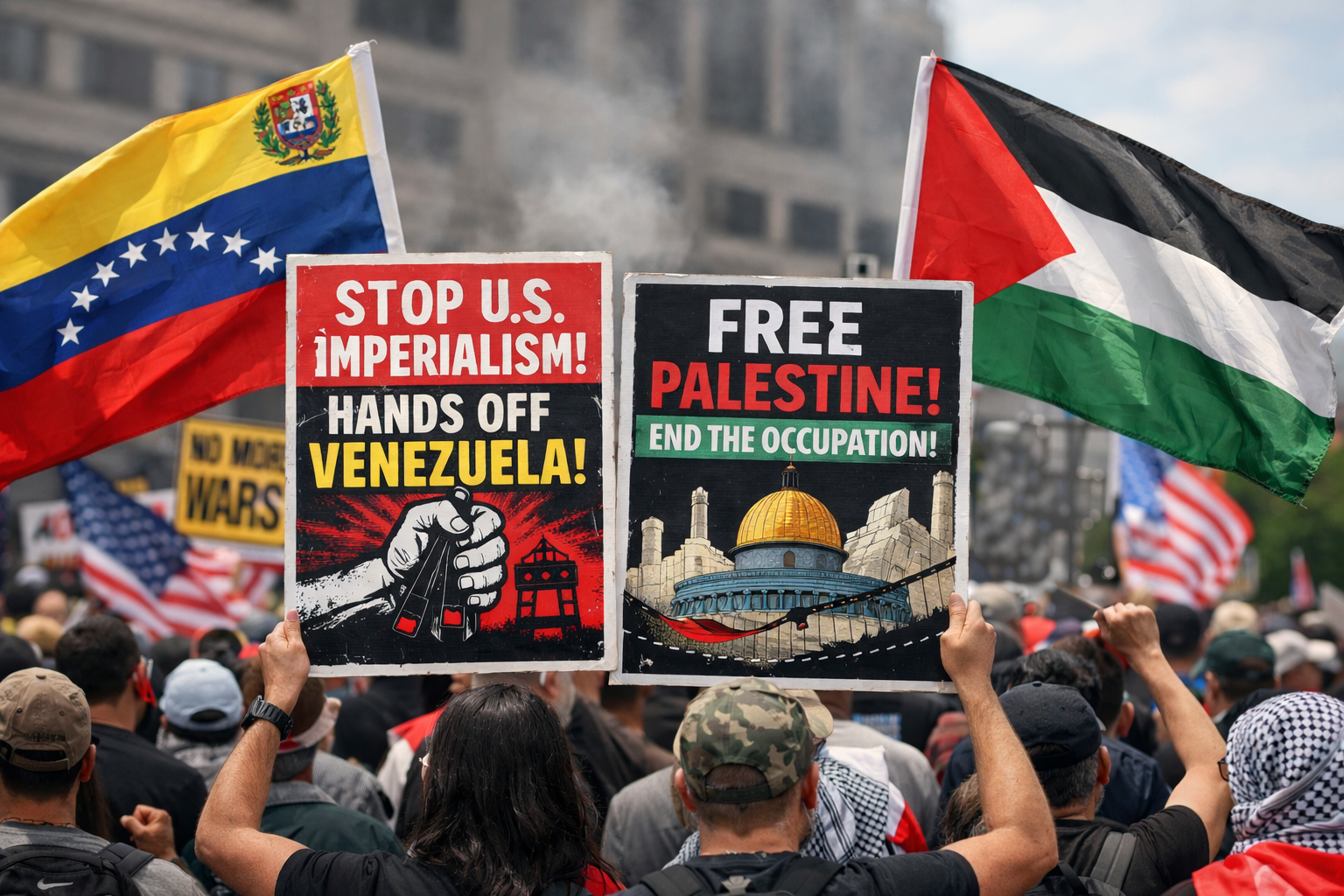
The United States ‘regime change’ operations in Venezuela have escalated into direct attacks. The U.S. government has seized Venezuelan oil tankers and President Donald Trump has declared a “total and complete blockade” on oil tankers entering and leaving Venezuela.
The United States has dramatically escalated its military presence in the Caribbean and northern South America.
- Over 15,000 U.S. troops deployed in the region. This represents the most significant U.S. military build-up in the region since the Cuban Missile Crisis in 1962, sharply increasing the risk of a wider regional conflict.
- Vessels are routinely bombed and over 100 people have been killed, described as War Crimes. False allegations linking Venezuela to international drug trafficking are routinely deployed to justify intervention. These claims function as political pretexts for militarisation and regime-change operations.
The U.S. has now openly declared its intention to control Venezuelan resources and assets. Trump has openly asserted that the United States has “oil rights” and even “land rights” in Venezuela. These statements amount to naked imperialist claims over a sovereign country that possesses the world’s largest proven oil reserves.
Venezuela’s Military Capacity and Deterrence
Venezuela’s military and civilian defence structures remain intact, organised, and loyal to the government:
- 123,000 active military personnel
- 8,000 reservists
- A Bolivarian Militia of approximately 350,000 members
This broad civilian–military mobilisation reflects substantial popular support for Venezuelan sovereignty. It also constitutes a significant deterrent to U.S. military aggression.
The U.S. Backed Opposition
Venezuelan opposition figure María Corina Machado has openly aligned herself with U.S. imperial interests. She has:
- Supported foreign intervention to remove Chávez- and Maduro-aligned governments
- Welcomed U.S. naval deployments and economic sanctions
These sanctions have devastated living conditions for ordinary Venezuelans, generating shortages, inflation, and widespread social hardship.
U.S. Targets Latin America: Threats Against Colombia, Mexico, and Cuba
Under U.S. policymakers such as U.S. Secretary of State Marco Rubio, who built his political career advocating the overthrow of the Cuban revolution, Washington has intensified explicit regime-change efforts, including renewed threats against Cuba. The broader strategy targets Latin America as a whole—Venezuela, Cuba, Colombia, and Mexico—with governments that pursue independent paths increasingly framed as obstacles to U.S. dominance.
Trump has publicly targeted Colombia’s President Gustavo Petro, warning that he could be “next” if he does not change course. President Petro’s opposition to U.S. militarism, including at international forums such as COP, has made him a growing target.
Mexico’s President has explicitly condemned the blockade and U.S. militarisation, calling on the United Nations to prevent bloodshed and to uphold national sovereignty. Mexico has warned that continued escalation risks dragging the entie region—including Cuba and Venezuela—into conflict.
Regional Fragmentation and the Extreme Right
Latin American unity has been undermined by the rise of far-right governments and movements, including:
- Argentina: President Javier Milei, an ardent supporter of Donald Trump.
- Chile: The recent election of José Antonio Kast—son of a Nazi Party member, admirer of Pinochet, staunch Catholic opponent of abortion and same-sex marriage, campaigning on mass migrant expulsions.
These forces align ideologically and politically with U.S. imperialist strategy, weakening regional resistance.
Overall Assessment
The blockade, military escalation, and promotion of compliant opposition figures constitute a coordinated and destabilising assault on Venezuelan sovereignty. This represents:
- A concerted regime-change operation
- Signalling the pursuit of U.S. strategic and economic interests by coercive means and the revival of the Monroe Doctrine—Trump style – threatening Latin America.
II. U.S. NATIONAL SECURITY STRATEGY (NSS) 2025: REVIVAL OF THE MONROE DOCTRINE
The Trump administration’s National Security Strategy (NSS) 2025 is an important document for understanding the current context of U.S. imperialism’s strategic considerations and shifts. It marks a change, a reversal of Washington’s project of a US-led globalism.
The document states, “The days of the United States propping up the entire world order like Atlas are over.”
China and Asia: Key Shifts
From Military Containment to Economic Competition
- China is no longer framed primarily as a military threat. The focus shifts to economic rivalry and emphasis on “economic rebalancing”.
- Condition: China must not challenge U.S. dominance in the Western Hemisphere
Economic and Strategic Containment
Instead, the U.S. pursues:
- Tariff wars and export controls
- Supply-chain decoupling
- Military deterrence without escalation
The NSS states:
“We will rebalance America’s economic relationship with China… accompanied by a robust and ongoing focus on deterrence to prevent war in the Indo-Pacific.”
Asia Downgraded; Western Hemisphere becomes top priority
- The first and overriding priority is no longer Asia or Europe, but the Western Hemisphere.
- This shift marks a move from globalism to spheres-of-influence geopolitics.
The “Trump Corollary” to the Monroe Doctrine
NSS 2025 explicitly revives and hardens the Monroe Doctrine:
“After years of neglect, the United States will reassert and enforce the Monroe Doctrine to restore American preeminence in the Western Hemisphere… We will deny non-Hemispheric competitors the ability to own or control strategically vital assets in our Hemisphere.”
The document spells out Washington’s objectives clearly:
- Block China (and other rivals) from Latin America
- Control strategic assets, supply chains, and transit routes
- Replace independent governments with compliant ones
- Prevent migration through coercion and militarisation
This is the strategic framework behind:
- Threats and blockade against Venezuela
- Pressure on Colombia and Mexico
- Renewed hostility toward Cuba
In short, the full domination of the Americas and exclusion of rival imperialist powers.
South China Sea and Taiwan
U.S. commitments are narrowed to:
- Keeping sea lanes open
- Preserving Taiwan’s de facto independence—primarily due to semiconductor supply chains
Burden-Shifting to Allies
- Japan and South Korea pressured to raise military spending from ~1% to 5% of GDP
- Implicit threat of U.S. withdrawal
Fortress America Economics
- Reindustrialisation, tariffs, reshoring
- Rejection of free trade and globalisation
Philippines: Strategic Complacency
- Continued reliance on U.S. security guarantees
- Increasingly untenable under NSS 2025
Broader NSS 2025 Themes
- Rejection of U.S.-led globalism
- Spheres of influence replace ‘liberal’ interventionism
- Revival of the Monroe Doctrine
- Economics as the foundation of power
- Rejection of multilateral institutions
- Hostility toward allies, with Europe framed as a “civilizational failure”
- Anti-immigration and ‘national identity’ (aligned with White Supremacist views) elevated to a national security issue
- Isolationism with coercive enforcement.
Overall Takeaway
NSS 2025 marks a shift from hegemonic globalism to continental nationalism: protectionist, transactional, exclusionary, and coercive within its own sphere.
III. PALESTINE: GAZA AND THE U.S. NEOCOLONIAL ‘PEACE PLAN’
The Trump Gaza ‘Peace Plan’: Gaza as a Neocolonial Project
Under the current U.S. brokered Gaza ‘peace plan’ (Comprehensive Plan to End the Gaza Conflict, of October 9, 2025), Gaza is being reshaped under joint Israeli–U.S. neocolonial occupation in which the Palestinian people are entirely excluded from decision-making.
Any real peace plan must end Israeli occupation and Palestinians need to be in the driver’s seat.
Just as the colonialist British 1917 Balfour Declaration, which declared a homeland for Jews on already occupied Palestinian land, with a “mandate system” of administrators chosen from the winners from the break-up of the Ottoman Empire after World War I, the Trump plan bestows Gaza’s “redevelopment” on his handpicked “Board of Peace”, with Trump at the helm of a “Board of Peace”, alongside war criminal and former British Prime Minister Tony Blair.
Meanwhile, Israel continuously violates the ‘ceasefire’, supposedly the first stage of the plan, with daily attacks, bombing and shelling of Gaza, killing hundreds of Palestinians, and blocking vital humanitarian aid.
UN “Mandate 3.0”: Against Palestinian Self-Determination
The UN Security Council adopted a resolution on November 17 that endorsed United States President Donald Trump’s plan for Gaza.
- Legitimises occupation
- Rebrands military control as “stabilisation”
- Provides political cover for Israeli occupation.
Thirteen of 15 member states voted for the resolution on November 17. Decisively, instead of using their veto power, as the US did to protect Israel, permanent council members China and Russia abstained.
Attacks on the Palestine Solidarity Movement
Across imperialist countries, Palestine solidarity is being criminalised:
- Surveillance and intimidation
- Protest bans and legal repression
Weaponisation of “Antisemitism”
- Legitimate criticism of Israel and Zionism is reframed as antisemitism
- Israel is shielded from accountability
- Genuine anti-racist struggle is undermined
Convergence with the Far Right
- Anti-immigration and Islamophobic narratives intensify
- Governments respond by suppressing protest
- Repression strengthens far-right forces
Why This Matters
The Palestine solidarity movement:
- Is a mass anti-far-right movement
- Links anti-racism, anti-imperialism, and democratic rights
- Directly challenges imperialism
This is precisely why it is under sustained attack.
IV. OUR KEY TASKS
As socialists, we adopt an internationalist perspective. We are socialist internationalists, not national democrats.
- Be informed: Participate in online webinars and political education
- Share and discuss international statements within chapters
- Initiate and actively join solidarity actions prioritising Free Palestine and Gaza and Venezuela Solidarity campaigns.
 Building the Philippine Socialist Movement Today