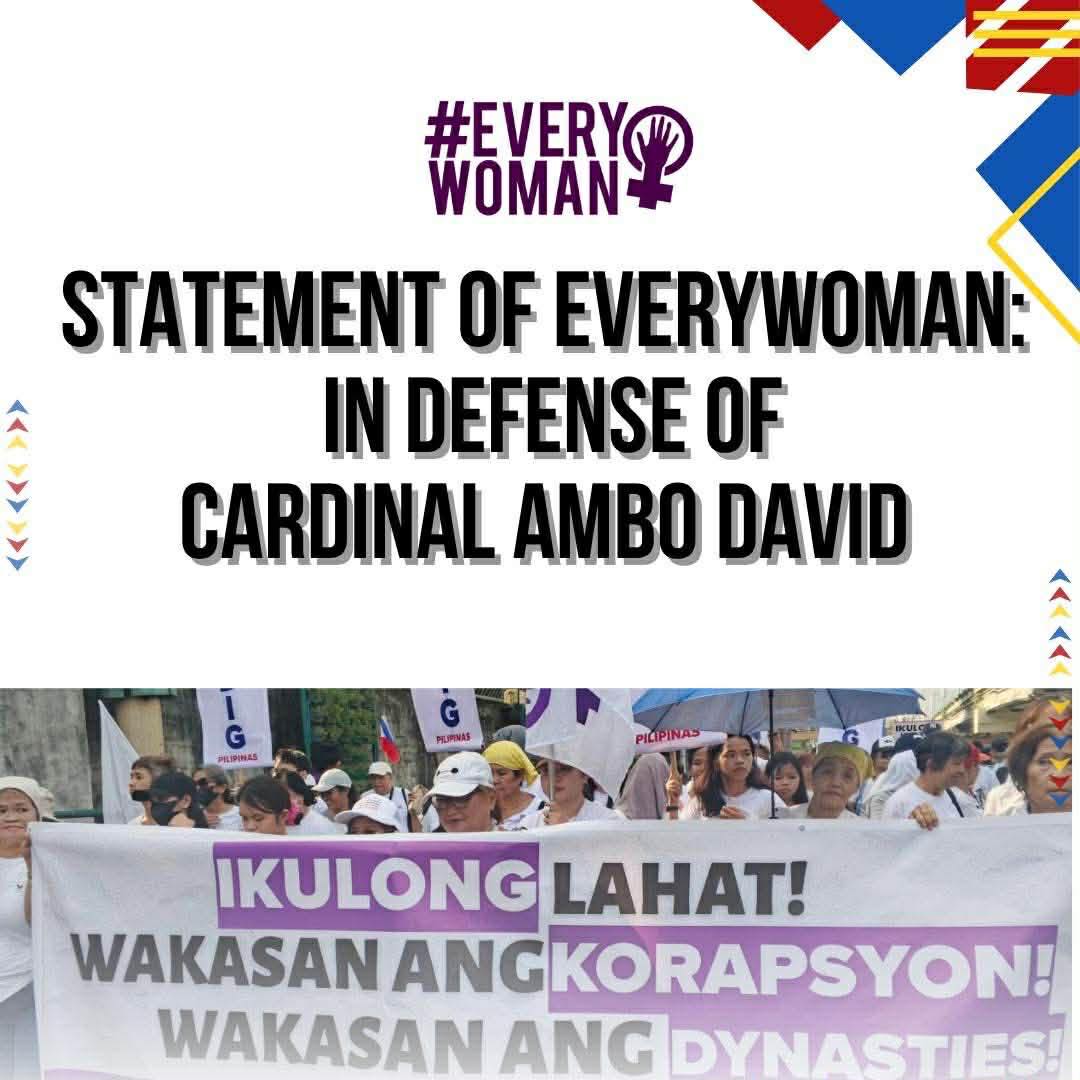
THANK YOU for your thoughtful response. On behalf of our organization PLM (Partido Lakas ng Masa), we appreciate the effort to clarify Cardinal Ambo David’s remarks and the intentions of the Trillion Peso March organizers. Dialogue is essential, and differences among democratic forces should always be handled with respect.
We fully acknowledge that movements adopt different calls based on their assessment of public sentiment and political timing. That is normal in any democratic process. Disagreements and differences are not betrayals. Even in our grassroots organizing, we always encounter divergent views from the masses, and it is fruitful to have open, friendly, and constructive discussion to find common ground. The same is true with progressive movements, including yours.
We appreciate the clarification that Cardinal David did not intend to sow division, that he was merely stating the fact that the Trillion Peso March organizers had not reached consensus on the Luneta calls. I do not intend to attack the personal integrity of Cardinal Ambo, nor the sincerity of the EDSA organizers. I wrote in haste and dismay, when many of my comrades felt unfairly lumped with the call for TRG (transitional revolutionary government) by the Duterte forces and certain military elements.
We believe the Trillion Peso March and the Baha sa Luneta organizers share the same commitments to end corruption and dismantle political dynasties. Weeks before November 30, we tried to find ways to unify the actions, knowing that fragmentation only emboldens anti-democratic and authoritarian forces seeking to divert or suppress the protest movement.
Days before November 30, we also held a press conference, alongside anti-dynasty leaders and electoral reform leaders, to encourage broader discussion on different approaches to fighting corruption and political dynasties. One concrete proposal was hosting a round-table discussion between EDSA and Luneta organizers to assess various frameworks and find practical unity.
We recognize that the range of political calls span the pursuit of constitutional processes, particularly those addressing political dynasties, as well as extra-constitutional proposals that reject both military coups and civilian-military juntas. We have been advocating an open, honest discussion of these approaches instead of public denunciations. Unfortunately, these efforts clearly require more time and deeper engagement.
We still hope for joint actions, such as the coming February 25 protest mobilizations, to project unity against corruption and dynastic rule. A platform where speakers can express different perspectives (excluding of course the ‘Sara Duterte takeover’ line). It would powerfully signal that we reject both authoritarian restorations and military interventions. I agree with you that the real danger of a junta lies with those forces aligned with the Dutertes.
I want to state clearly that I agree with your calls: of holding all the corrupt to account, whether aligned with the administration or the Dutertes, abolishing all political dynasties, and rejecting any military action aimed at installing a civilian-military junta in any form.
However, we do not see our Resign Call and the establishment of people’s transition council (PTC) contrary to your calls. We consider your formulation an “umbrella call” capable of uniting different groups pursuing distinct but complementary approaches toward the broad aims of today’s protest movement.
Our calls did not emerge from some form of military adventurism or illusions about the role of the military. They arise from long-standing deliberations, helping develop mass movements and our involvement in campaigns demanding accountability, anti-dynasty reforms, and structural transformation. They are not schemes for power grabs. These proposals are subject to debate and refinement, but they should not be dismissed as dangerous or chaotic without engaging the substantive points we have raised.
Other countries wracked with corruption crises have pursued transitional mechanisms, not military juntas, but broad civilian-led processes and interim civilian governments. These examples do not erase our justified mistrust of the Philippine military, but they show that democratic transitions are neither impossible nor inherently reckless.
We can disagree on specific formulations, but as long as our commitment is to eradicate corruption and end dynastic rule, I think we will be on the right track. Unity is urgently needed today, and will remain crucial heading toward the 2028 elections, which is another arena for pursuing systemic change.
For clarity, I myself did not subscribe to Resign All since 2000. It’s only until recently. Tactical calls must always reflect the character and mood of the struggle at the moment, and not permanent for all time. During the September 21 rally, we adopted the general call of “Jail All” those implicated in corruption, as it was the call already reverberating in youth protests (“Mga kurakot, ikulong na yan”).
It was only after September 21 that we recognized the call for Resign All resonated with the public, expressing widespread disgust that the system of corruption is deeply rooted in the pervasive rule of the dynasties.
Calls for “Resign All” and for a People’s Transition Council are not unconstitutional. There is nothing in the constitution that prohibits those calling for resignation and proposing alternative political arrangements, such as the PTC, as long as these are pursued through peaceful, democratic, and civilian forms of mobilizations.
The PTC proposal is an adjunct to Resign All. It affirms that political change must come from the people, not dynasties. It envisions representation from marginalized sectors, the middle class, and trusted reform-minded personalities. It is not an imposition, nor a rigid blueprint.
Later discussions include proposals for people’s assemblies or Kompil-type assemblies which are broad, inclusive, sector-based, and where civil society representation deliberates on who should comprise the PTC. These assemblies could also evolve into a mass political center capable of unified mobilizations and democratic consultation. Defining its contours is not up to any individual or even organization; it belongs to a participatory process involving public consultation and engagement, people’s assemblies and other forms.
Respectful discussion requires careful honesty about where we differ. We agree that the Dutertes pose an extreme danger in their bid to recapture power. But the current corruption scandal is unprecedented in scale, and accountability cannot stop where political alliances begin. If we avoid naming those responsible who are in the top echelon of power, we risk shielding the very actors implicated in the plunder.
In the spirit of unity, we welcome continued dialogue and seek common ground on holding all the corrupt accountable, preventing any faction of the ruling elite from hijacking people’s anger, and ending impunity and the culture of corruption entrenched by political dynasties.
Those who know me and my circle understand that we stand for socialist feminism, and firmly believe that any serious reform process must place women’s issues and women’s liberation at the forefront. It is essential that progressive women’s organizations participate and lead such dialogues.
In this spirit, may I suggest that we pursue a dialogue with you that could pave the way for a round-table discussion among the EDSA and Luneta groups? You have raised other important questions that I have not addressed here. I think we need a format that is appropriate for a more in-depth discussion: a face-to-face meeting.
Again, thank you for your engagement. I hope whatever differences we hold today will be bridged through more exchanges. What matters is we keep our conversation going, in the bounds of honest, principled, and focused discussion on the interest of the masses we all seek to serve.
Sonny Melencio
Chairperson, Partido Lakas ng Masa (PLM)
 Building the Philippine Socialist Movement Today